Fraction Calculator Quick Answer
Built and tested by the Mathvelo team · Last updated: October 2026 · Every worked example here was recomputed with exact arithmetic before publishing.
A fraction calculator works out sums, differences, products and quotients and returns the result in lowest terms, as a mixed number and as a decimal. For 3/4 + 5/6 it finds the least common denominator (LCD) 12, rewrites the fractions as 9/12 + 10/12, and answers 19/12, which is 1 7/12.
How to Use This Fraction Calculator
- Pick a tab. Start with Calculate for the four operations, or choose Simplify, Decimals, Inches or Recipe.
- Type your numbers. A fraction is 3/4, a mixed number has a space, as in 2 1/3, and a negative takes one minus sign: −3/4.
- Read the working. Press Calculate for the answer in lowest terms and as a decimal, with the LCD, GCF and conversions listed underneath.
| Tab | What it does | Try this |
|---|---|---|
| Calculate | Chains up to five fractions with + − × ÷ | 1/3 + 1/4 + 1/6 = 3/4 |
| Simplify | Reduces to lowest terms | 84/126 = 2/3 |
| Mixed numbers | Converts mixed ⇄ improper | 17/5 = 3 2/5 |
| Decimals | Converts both ways, repeating decimals too | 1.375 = 11/8 |
| Compare | Sorts any list of fractions | 3/5 < 2/3 < 7/10 |
| Inches & tape | Nearest tape-measure mark | 0.4375 in = 7/16 in |
| Recipe scaling | Scales a whole ingredient list | 3/4 cup for 4 → 1 1/8 for 6 |
| Partial fractions | Splits a rational expression | (3x+5)/((x−1)(x+2)) |
How to Add and Subtract Fractions With Different Denominators
Fractions can only be added when the slices are the same size, so the denominators must match first. Find the least common denominator, rewrite each fraction over it, then add or subtract the numerators and keep the denominator.
3/4 + 5/6
- The LCD of 4 and 6 is 12.
- 3/4 = 9/12 and 5/6 = 10/12.
- 9/12 + 10/12 = 19/12.
- 19/12 is an improper fraction, so write it as 1 7/12.
Answer: 1 7/12
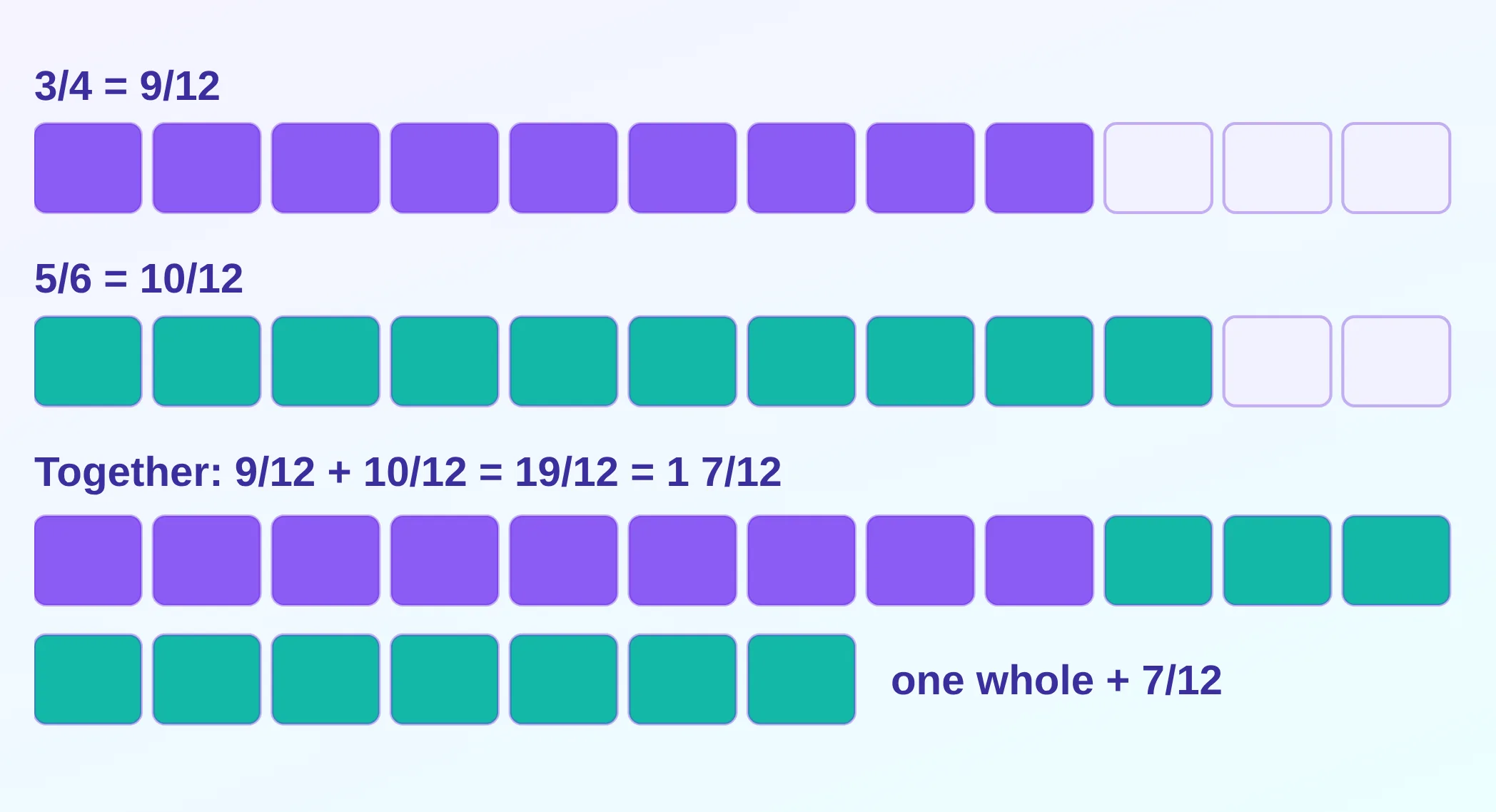
Subtraction works the same way. For 7/12 − 1/8 the LCD is 24, so 14/24 − 3/24 = 11/24. Using the LCD rather than just multiplying the denominators keeps the numbers small and the answer easier to reduce.
How to Multiply and Divide Fractions
Multiplying needs no common denominator: multiply the numerators, multiply the denominators, then reduce. Cancelling common factors first, as in 3/5 × 10/9 = (3×10)/(5×9) = 30/45 = 2/3, keeps the numbers small.
To divide, multiply by the reciprocal. The rule “flip the second fraction” works because dividing by 5/12 asks how many 5/12 pieces fit, and each whole holds 12/5 of them. So 5/6 ÷ 5/12 = 5/6 × 12/5 = 2.
2/3 ÷ 4/9
- Flip the divisor: 4/9 becomes 9/4.
- Multiply: 2/3 × 9/4 = 18/12.
- Reduce by 6: 3/2, which is 1 1/2.
Answer: 1 1/2
A quick check: 1 1/2 × 4/9 should give back 2/3, and it does. Multiplying the answer by the divisor is the fastest way to catch a flipped fraction.
Simplify Fractions and Convert Mixed Numbers
A fraction is in lowest terms when the numerator and denominator share no factor but 1. Divide both by their greatest common factor (GCF): 84/126 divides by 42 to give 2/3. The GCF and LCM calculator shows how the factor is found.
To turn an improper fraction into a mixed number, divide: 17 ÷ 5 is 3 remainder 2, so 17/5 = 3 2/5. To go back, multiply the whole by the denominator and add the numerator: 3 × 5 + 2 = 17, giving 17/5.
Fraction to Decimal and Decimal to Fraction
Divide the numerator by the denominator: 3/8 = 0.375. Some fractions repeat forever, so 1/7 = 0.142857… with a repeating block. This calculator stores exact integer fractions and converts only for display, which avoids the JavaScript trap where 0.1 + 0.2 gives 0.30000000000000004.
For a terminating decimal, put it over a power of ten and reduce: 1.375 = 1375/1000 = 11/8. For a repeating one, subtract a shifted copy: x = 0.(142857) gives 1,000,000x − x = 142857, so x = 1/7. Multiply a fraction by 100 for its percent: 3/8 = 37.5%, and 5/8 = 62.5%. Reverse it by dividing the percent by 100 and reducing, so 62.5% = 625/1000 = 5/8.

Inch Fractions, Recipes and Partial Fractions
Tape measures use 1/16 and 1/32 marks, so 0.4375 in × 16 = 7 puts the mark at 7/16. A recipe for 4 that must serve 6 multiplies every amount by 3/2, so 3/4 cup becomes 1 1/8 cups. In algebra, partial fraction decomposition splits (3x+5)/((x−1)(x+2)) into 8/3 · 1/(x−1) + 1/3 · 1/(x+2), which is the first step in many integrals.

Fraction Mistakes That Cost the Most Marks
Three slips account for most lost marks on fraction homework, and each one is easy to catch once you know it.
- Adding straight across. 2/3 + 1/4 is not 3/7. The pieces are different sizes, so convert to twelfths first: 8/12 + 3/12 = 11/12.
- Forgetting to reduce. 6/8 is correct but unfinished. Dividing by the GCF 2 gives 3/4, and most teachers expect that form.
- Flipping the wrong fraction. Only the divisor turns upside down. In 3/4 ÷ 2/5, flip 2/5 to get 3/4 × 5/2 = 15/8, which is 1 7/8.
3 1/2 − 1 3/4
- Convert to improper fractions: 7/2 − 7/4.
- Use the LCD 4: 14/4 − 7/4.
- Subtract: 7/4, which is 1 3/4.
Answer: 1 3/4
Our Take: What Is Overrated, Underrated and Plain Wrong
Overrated: hand-drawing fraction pies. They help once, but common denominators carry most of the work.
Underrated: simplifying before multiplying. 8/15 × 5/12 is far easier after cancelling 5 and 4 first.
Plain wrong: “cross-adding” 1/2 + 1/3 as 2/5. Adding denominators is never right; the answer is 5/6.
Fraction Practice Problems With Answers
Work each on paper, then compare with the calculator’s steps.
- 2/5 + 3/10
Answer
7/10 - 7/12 − 1/8
Answer
11/24 - 3/5 × 10/9
Answer
2/3 - 5/6 ÷ 5/12
Answer
2 - 3 1/2 − 1 3/4
Answer
1 3/4
Written by the Mathvelo team, who do not claim a teaching credential. Every method is shown so you can check it. See About, Contact, Privacy and Terms, or report a mistake.
Why Students Get Stuck on Fractions, and What a Good Calculator Should Do
Searching for help with fractions usually starts late at night with one problem that will not work out. Common denominators, simplifying and mixed numbers each have their own traps. A good calculator fixes that by showing each step, checking its own answer and explaining the idea in plain words. This section covers what students struggle with, what they want, and how this page responds.
In short: students need to keep a clear routine for every operation, not just see a final number, and a calculator earns trust only when its steps can be checked.
Understand the pain points
What students get stuck on
Most mistakes here are not about arithmetic. They come from one rule applied the wrong way round, which is why seeing every step matters.
- Adding the numerators and the denominators3/4 + 5/6↗
- Forgetting to find a common denominator2/3 * 9/10↗
- Not simplifying the final answer7/8 - 1/3↗
- Flipping the wrong fraction when dividing5/6 divided by 2/3↗
Understand the frustrations and desires
What they feel, and what they want
Each frustration points to a wish: a clearer step, a built-in check, an explanation in plain words.
- Wants each operation shown in its own line
- Wants the answer as a mixed number and a decimal
- Wants the simplest form every time
Build the page around their intent
Each intent has a place on this page
The page follows intent, not features, so each need has a clear starting point.
- I need an answer now: type the problem into the calculator at the top of this page.3/4 + 5/6↗
- I need to understand: the sections below explain the idea in plain words and list the common mistakes.
- I need to check my work: every step is shown, so the first line that differs from yours is the one to study.
- I need practice: open the solver, tap + and choose Create Practice Test.
- I need it explained aloud: in the solver, tap + and choose Create Video.