What Does Solve for x Mean?
Built and tested by the Mathvelo team · Last updated: October 2026 · Every worked example here was recomputed with exact arithmetic before publishing.
An equation is a balanced scale, and solving for x means finding the value that keeps it level. Read 2x − 4 = 10 aloud: twice a number, minus four, is ten. Add 4 to both sides, divide by 2, and x = 7. Check: 2(7) − 4 = 10. Every step applies the same inverse operation to both sides, which is why the equation stays true.
How to Use the Solve for X Calculator With Steps
- Enter the equation. Type it, speak it, draw it or upload a photo, then fix any misread symbol.
- Press Solve. Each step names the inverse operation it used. Worded problems go to the AI tutor.
- Check and ask. The last line puts x back into your equation. Ask a follow-up for another method.
How to Solve for x: Pick the Type First
The first move depends on what the equation looks like, so name the type before you start.
| What you see | Type | First move |
|---|---|---|
| 3x + 5 = 11 | Linear | Undo + and −, then divide |
| (x + 2)/3 = (x − 1)/2 | Fractions | Multiply by the common denominator |
| x² − 5x + 6 = 0 | Quadratic | Factor or use the formula |
| 3/x = 12/20 | Proportion | Cross-multiply |
| log₂ x = 5 | Log | Rewrite as 2⁵ = 32 |
| 2ˣ = 20 | Exponent | Take a log of both sides |
| √(x + 7) = x + 1 | Radical | Isolate, square, then check |
| |x − 3| = 5 | Absolute value | Split into two cases |
Solve for x With Fractions and Brackets
Multiply both sides by the common denominator 6
- 2(x + 2) = 3(x − 1).
- 2x + 4 = 3x − 3.
- Subtract 2x and add 3: x = 7.
- Check: 9/3 = 3 and 6/2 = 3.
Answer: x = 7
Expand first
- 3x + 6 = x + 14.
- 2x = 8.
- x = 4.
Answer: x = 4

Solve for x in a Quadratic Equation
Try factoring first: x² − 5x + 6 = 0 becomes (x − 2)(x − 3) = 0, so x = 2 or x = 3. When it will not factor, use the quadratic formula. For 2x² + 3x − 2 = 0 the discriminant is 3² − 4(2)(−2) = 25, so x = (−3 ± 5) ÷ 4, giving x = 1/2 or x = −2. A positive discriminant means two real roots, zero means one and a negative value means none. The curve crossing the x-axis at the same points confirms it.
Our quadratic equation calculator and factoring calculator go deeper on each method.
Solve for x With Logs, Exponents and Radicals
To undo a log, rewrite it as a power: log₂ x = 5 means x = 2⁵ = 32. To undo an exponent, take a log: 2ˣ = 20 gives x = log 20 ÷ log 2 ≈ 4.32. To undo a square root, square both sides, but then check every answer, because squaring can create a false one.
Square both sides
- x + 7 = x² + 2x + 1, so x² + x − 6 = 0.
- (x + 3)(x − 2) = 0, so x = −3 or x = 2.
- Check x = −3: √4 = 2, but x + 1 = −2, so it fails.
- Check x = 2: √9 = 3 and 2 + 1 = 3, so it works.
Answer: x = 2 only (−3 is an extraneous solution)

Solve for x in a Diagram: Triangles, Parallel Lines and Parallelograms
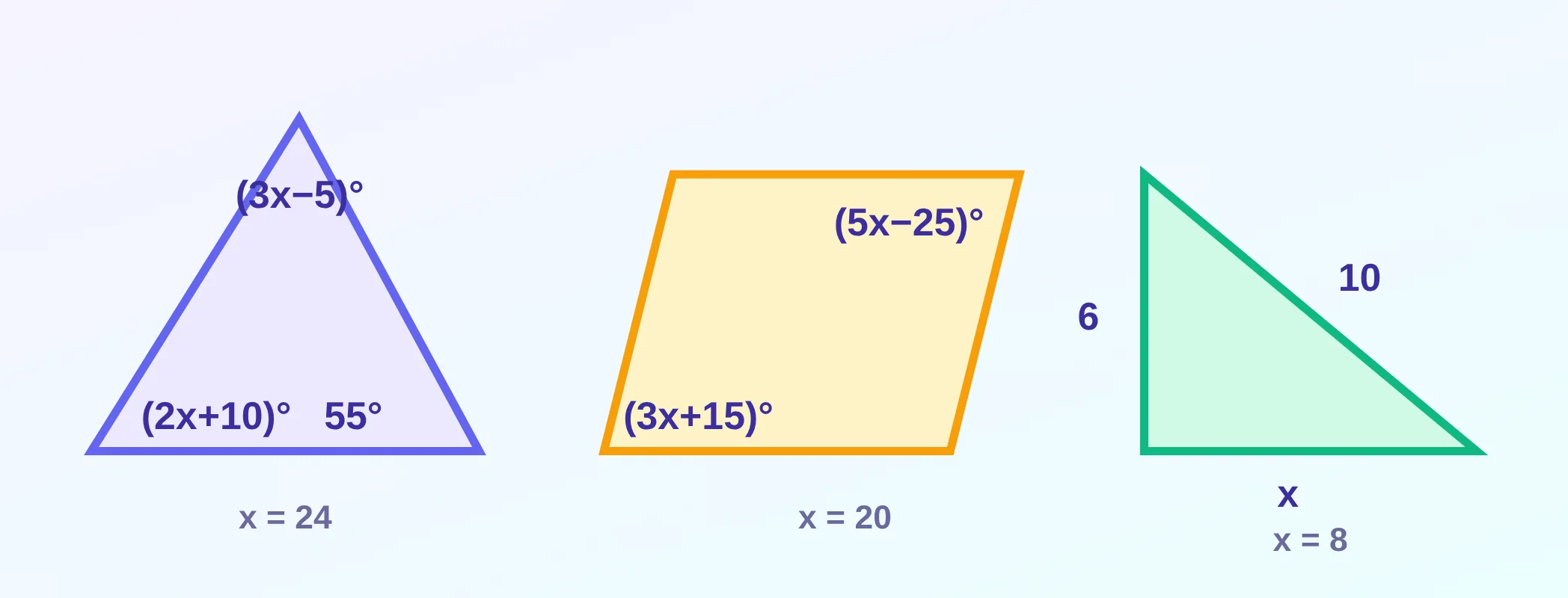
Geometry problems become equations once you pick the right rule. Angles in a triangle add to 180°, so 2x + 10, 3x − 5 and 55 give 5x + 60 = 180 and x = 24. Opposite angles of a parallelogram are equal, so 3x + 15 = 5x − 25 gives x = 20. In a right triangle with legs 6 and x and hypotenuse 10, Pythagoras gives 36 + x² = 100, so x = 8.
Solve for x in a Formula, a Proportion or a System
Solving a formula for x works exactly like a number equation. From y = mx + b, subtract b and divide by m to get x = (y − b) ÷ m. For a proportion, cross-multiply: 3/x = 12/20 gives 12x = 60, so x = 5. For a system such as x + y = 10 and x − y = 2, add the equations to get 2x = 12, so x = 6 and y = 4. An absolute value like |x − 3| = 5 is a distance question, so x = −2 or x = 8.

Solve for x Word Problems
Worded problems need one extra step: define x. “Three consecutive integers add to 72” becomes x + (x + 1) + (x + 2) = 72, so 3x + 3 = 72 and x = 23, giving 23, 24 and 25. “A jacket costs $60 after 20% off” becomes 0.80x = 60, so x = 75. Say in words what x stands for before you write the equation, and check the answer against the story, not only against the algebra.
Common Mistakes When Solving for x
- Changing only one side. Subtracting 6 from the left but not the right breaks the balance.
- Dropping a bracket sign. In 3(x − 2), the 3 multiplies both terms: 3x − 6, not 3x − 2.
- Dividing by a variable. Dividing x² = 5x by x loses the root x = 0. Move everything to one side and factor instead: x(x − 5) = 0.
- Skipping the check. Fractions with x in the denominator, roots and logs can all give answers that do not satisfy the original equation.
Our Take: What Is Overrated, Underrated and Plain Wrong
Overrated: memorising separate recipes for each equation type. Inverse operations cover most of them.
Underrated: substituting the answer back in. It is the cheapest check there is.
Plain wrong: dividing both sides by an expression that could be zero. You can lose a valid solution that way.
Solve for x Practice Problems With Answers
Try each by hand first.
- 3x + 5 = 11
Answer
x = 2 - 5(x − 2) = 3x + 4
Answer
x = 7 - 3/x = 12/20
Answer
x = 5 - x² − 5x + 6 = 0
Answer
x = 2 or x = 3 - |x − 3| = 5
Answer
x = −2 or x = 8
Written by the Mathvelo team, who do not claim a teaching credential. Every method is shown so you can check it. See About, Contact, Privacy and Terms, or report a mistake.
Why Students Get Stuck on Solving for x, and What a Good Calculator Should Do
Searching for help with solving for x usually starts late at night with one problem that will not work out. Each step is easy, and the order of steps is where it goes wrong. A good calculator fixes that by showing each step, checking its own answer and explaining the idea in plain words. This section covers what students struggle with, what they want, and how this page responds.
In short: students need to isolate x one inverse operation at a time, not just see a final number, and a calculator earns trust only when its steps can be checked.
Understand the pain points
What students get stuck on
Most mistakes here are not about arithmetic. They come from one rule applied the wrong way round, which is why seeing every step matters.
- Doing something to only one sideSolve 3x + 7 = 22↗
- Sign errors when moving termsSolve 2(x - 4) = 3x + 1↗
- Distributing wrongly over bracketsSolve x/3 + 2 = 7↗
- Not checking the answer by substitutionSolve 5x - 3 = 2x + 9↗
Understand the frustrations and desires
What they feel, and what they want
Each frustration points to a wish: a clearer step, a built-in check, an explanation in plain words.
- Wants every inverse step named
- Wants the answer checked in the original
- Wants fractions and brackets handled
Build the page around their intent
Each intent has a place on this page
The page follows intent, not features, so each need has a clear starting point.
- I need an answer now: type the problem into the calculator at the top of this page.Solve 3x + 7 = 22↗
- I need to understand: the sections below explain the idea in plain words and list the common mistakes.
- I need to check my work: every step is shown, so the first line that differs from yours is the one to study.
- I need practice: open the solver, tap + and choose Create Practice Test.
- I need it explained aloud: in the solver, tap + and choose Create Video.