Free Loan Calculator: Quick Answer
A loan payment is the amount you pay each period so that the balance reaches zero at the end of the term. For a fixed-rate loan it is payment = P × i ÷ (1 − (1 + i)−n), where P is the amount borrowed, i is the interest rate for one period and n is the number of payments. The free loan calculator above does this for you and shows the total interest, the payoff date and the full schedule.
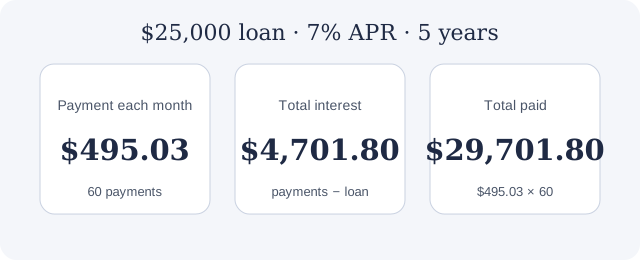
For example, a $25,000 loan at 7% over 5 years has a payment of $495.03 a month, total interest of $4,701.80 and a total cost of $29,701.80.
What This Loan Calculator Helps You Decide
Most people open a loan calculator with one of four worries. Each has its own tab above, so you do not have to rearrange the maths yourself.
- “What will this cost me each month?” Use Loan payment. Enter the amount, the term and the rate, and you get the payment, the total interest and every payment in a schedule.
- “How much can I afford to borrow?” Use Solve for…. Enter the payment that fits your budget and it works backwards to the loan amount. It can also find how long a loan will take at a given payment, or the rate you are really paying.
- “Two lenders gave me two offers. Which is cheaper?” Use Compare loans. It lines up payment, total interest, fees and APR side by side.
- “What if I pay extra?” Open Extra payments in the first tab to see the interest you save and how much sooner you finish.
A fifth tab, Lump sum & bond, covers loans repaid in a single payment at the end, including zero-coupon bonds.
How to Use This Loan Calculator
- Enter the loan amount and pick your currency. It follows your device language by default.
- Set the term in years and months, and the interest rate as an annual percentage rate (APR). The slider moves in steps of 0.05%, and you can type any rate.
- Read the payment in the dark box, with total interest and the payoff date beside it. Tap a quick example (car loan, personal loan, mortgage or student loan) to see a typical setup.
- Open the options if you need them. Payment schedule and start date changes the payment frequency (monthly, twice a month, every two weeks, weekly, quarterly, half-yearly or yearly) and how often interest compounds. Extra payments adds a regular or one-time overpayment. Fees adds an origination fee so the calculator can show the APR with fees.
- Check the details. The chart shows the balance falling while interest paid rises. Show the steps explains each number, and Amortization schedule lists every year or every payment. You can download the schedule as a spreadsheet file, copy a summary, or copy a link that holds your inputs.
Everything is worked out in your browser. Only your currency is remembered on your device, and a shared link carries the numbers in the address.
How a Loan Payment Is Calculated
Every payment on a fixed-rate amortizing loan is the same size, and each one pays the interest owed first and sends the rest to principal. Three steps give the payment.
- Find the interest rate for one payment period. With a 7% APR compounded monthly and paid monthly, i = 7% ÷ 12 = 0.5833% per month.
- Find the number of payments. A 5-year loan with monthly payments has n = 5 × 12 = 60.
- Apply the formula. Payment = P × i ÷ (1 − (1 + i)−n).
Worked example: P = $25,000, i = 0.5833%, n = 60 gives a payment of $495.03. Over 60 payments that is $29,701.80, so the interest is $4,701.80. The first payment is $145.83 interest (25,000 × 0.5833%) and $349.20 principal.
The same formula sits behind the spreadsheet functions PMT in Excel and Google Sheets. The (1 + i)n part is ordinary compound growth, which you can explore with the exponent calculator. If you rearrange the formula to solve for the number of payments you need a logarithm, and the logarithm calculator shows how those work.
When the interest rate is 0%, the formula would divide by zero, so the payment is simply the loan amount divided by the number of payments. The calculator handles this case directly.
Types of Loans: Amortized, Interest-Only, Lump Sum and Bond
Loans differ mainly in when the principal comes back. The calculator covers the four shapes you will meet most often.
- Amortized loan. Equal payments at regular intervals until the balance is zero. Mortgages, car loans, student loans and most personal loans work this way. This is what people usually mean by “a loan”.
- Interest-only loan. You pay only the interest each period, and the whole principal is due with the last payment (a balloon payment). Payments are lower, but the balance does not shrink. Choose Interest-only under repayment type to see one.
- Deferred payment (lump sum) loan. No payments until maturity, when you repay principal plus all compounded interest in one go. At 6% compounded yearly for 10 years, a $100,000 loan grows to $179,084.77.
- Bond or zero-coupon loan. You are promised a fixed face value at maturity, and the amount handed over today is that value discounted by the interest rate. A $100,000 face value due in 10 years at 6% yearly is worth $55,839.48 today.
Use the Lump sum & bond tab for the last two. For a revolving credit card balance, a flat-rate loan or a variable-rate loan, the fixed-rate amortization formula does not apply exactly, so treat the results as an estimate.
Interest Rate, APR and APY: What Is the Difference?
The interest rate is the price of borrowing the principal. The APR (annual percentage rate) adds required lender fees, such as an origination fee, to that rate, so it describes the real yearly cost better. The APY (annual percentage yield) includes the effect of compounding and is the figure usually quoted for savings, but it is also what a lump-sum loan really costs per year. In the US, lenders must show the APR for many consumer loans, and the Consumer Financial Protection Bureau explains it in the difference between a loan interest rate and the APR.
Compounding changes the cost
Interest compounds when it is added to the balance and then earns interest itself. The more often it compounds, the more you owe for the same quoted rate. The calculator lets you choose daily, weekly, every two weeks, twice a month, monthly, quarterly, half-yearly, yearly or continuous compounding. For most consumer loans, monthly compounding with monthly payments is the standard.
Worked example: fees raise the APR
You borrow $16,000 for 5 years at 12% and pay a 5% origination fee ($800), so you receive $15,200 but repay the full $16,000. The payment is $355.91 a month. The rate that makes those 60 payments worth exactly $15,200 is about 14.28%, so the loan costs more than its 12% label. Enter 5 in the Origination fee box to see this in the calculator.
Loan Term: Shorter or Longer?
A longer term lowers each payment but raises the total interest, because the balance stays higher for longer. A shorter term does the opposite. The CFPB makes the same point about amortization in its guide to how amortization affects your loan.
A $20,000 loan at 12%
| Term | Monthly payment | Total interest | Total paid |
|---|---|---|---|
| 2 years | $941.47 | $2,595.27 | $22,595.27 |
| 3 years | $664.29 | $3,914.30 | $23,914.30 |
| 4 years | $526.68 | $5,280.48 | $25,280.48 |
| 5 years | $444.89 | $6,693.34 | $26,693.34 |
A $250,000 loan at 6.5%
| Term | Monthly payment | Total interest |
|---|---|---|
| 15 years | $2,177.77 | $141,998 |
| 20 years | $1,863.93 | $197,344 |
| 25 years | $1,688.02 | $256,405 |
| 30 years | $1,580.17 | $318,861 |
Going from 30 years to 15 years raises the payment by $598 a month but cuts total interest by roughly $176,863. Whether that is worth it depends on your budget, and the calculator lets you test any term in between.
How the Interest Rate Changes Your Payment
Small rate differences add up over a long loan. Here is a $25,000 loan over 5 years at five different rates. Each extra two points of rate adds roughly $23 to $25 to the monthly payment and about $1,400 to $1,500 of interest in this example.
| APR | Monthly payment | Total interest |
|---|---|---|
| 5% | $471.78 | $3,307 |
| 7% | $495.03 | $4,702 |
| 9% | $518.96 | $6,138 |
| 11% | $543.56 | $7,614 |
| 13% | $568.83 | $9,130 |
If you want to see the same change as a percentage, the percentage calculator turns two payments into a percent difference.
Amortization Schedule Explained
An amortization schedule lists every payment and splits it into interest and principal, with the balance left afterwards. Early in the loan most of each payment is interest, and over time the split reverses. The CFPB describes the same pattern, where the principal balance falls slowly at first and faster near the end.
On the $250,000 loan above, the first payment is 86% interest. The 180th payment, halfway through, is still 62% interest. That is why extra payments made early save the most.
To read the schedule, use Amortization schedule under the results. By year shows interest, principal and the ending balance for each year of the loan. Every payment shows all payments with dates, and Download CSV saves them for a spreadsheet. Totals in the calculator use the exact payment, so they can differ by a few cents from a lender statement that rounds each payment to the cent.
Extra Payments and Early Payoff
Any money you add on top of the required payment goes straight to principal, so the next interest charge is smaller. The effect grows the earlier you start. Here is a $200,000 loan at 6% over 30 years, with a required payment of $1,199.10 a month:
| Extra payment | Paid off in | Interest saved | Total interest |
|---|---|---|---|
| None | 30 years | $231,676 | – |
| $100 a month | 24 years 7 months | $182,538 | $49,138 |
| $200 a month | 21 years | $151,876 | $79,801 |
| $500 a month | 14 years 11 months | $102,535 | $129,142 |
Two more cases from the same loan. A single extra payment of $10,000 in the first month shortens the loan to 26 years 4 months and saves about $43,624. Paying one-twelfth of the payment extra each month ($99.93), which matches one extra payment a year, ends the loan after 24 years 7 months.
Before you pay extra, check the loan agreement for a prepayment penalty, a fee some lenders charge when you repay early. The CFPB explains how it works for mortgages in what a prepayment penalty is. Also tell the lender that the extra money is meant for principal, because some servicers apply it to future payments instead.
Enter an amount under Extra payments to try your own numbers, or use the One-time extra payment box for a bonus or tax refund.
Solve for Amount, Term or Rate
The Solve for… tab works the formula backwards. Fill in what you know and it finds the missing piece.
- How much can I borrow? Divide your budget into the loan. At $500 a month, 7% and 5 years, you can borrow about $25,251.00.
- How long to repay? A $20,000 loan at 7% with $450 a month takes about 51.6 payments, which is 52 payments with a smaller last one, or 4 years 4 months.
- What rate am I paying? Enter the amount, payment and term from an offer. There is no direct formula for the rate, so the calculator searches for the value that fits. This is a handy check against a quoted APR.
If the payment is smaller than the monthly interest, the loan never shrinks, and the calculator tells you so instead of giving a result.
Compare Two Loans Fairly
The lowest monthly payment is not always the cheapest loan. Compare total cost (interest plus fees), the APR with fees and the term. Here is one example, both for $25,000:
| Loan A | Loan B | |
|---|---|---|
| APR | 7.5% | 6.9% |
| Term | 5 years | 7 years |
| Origination fee | none | 2% ($500) |
| Monthly payment | $500.95 | $376.10 |
| Total interest | $5,057 | $6,592 |
| Interest + fee | $5,057 | $7,092 |
Loan B has the lower rate and a payment $124.85 lower each month, but it costs about $2,035 more in total because it runs two years longer and carries a fee. If the lower payment is what keeps your budget safe, B can still be the right choice, but it should be a deliberate one. Use the Compare loans tab to test your own offers.
Use It for a Car Loan, Mortgage, Personal Loan or Student Loan
The calculator fits any fixed-rate amortizing loan. A few notes on what to enter for each:
- Car loan. Enter the price minus your down payment and trade-in as the loan amount, and include sales tax and fees if you finance them. Terms are usually 3 to 7 years.
- Mortgage. The result is principal and interest only. Property tax, home insurance and mortgage insurance are paid on top, so the real monthly cost is higher. Use a 15-, 20- or 30-year term.
- Personal loan. Enter the amount you receive and the origination fee, if any, in the Fees box to see the APR with fees. Many personal loans are unsecured and so carry higher rates than secured ones.
- Student loan. For a fixed-rate loan already in repayment, enter the balance, the rate and the remaining term. Interest that builds up before repayment starts, or income-based plans, change the picture and are not modelled.
For a variable-rate loan, recalculate whenever the rate changes, using the current balance and the remaining term.
Secured and Unsecured Loans
A secured loan is backed by collateral, such as a house or a car. If you stop paying, the lender can claim the asset, which is called a lien. Because the lender takes less risk, secured loans usually have lower rates. An unsecured loan has no collateral, so lenders rely on your credit history and income instead, and rates are usually higher. Lenders often weigh the “five Cs of credit”: character (credit history), capacity (income against debts, often as a debt-to-income ratio), capital (savings and assets), collateral and conditions (the purpose and the lending climate). A cosigner, who agrees to repay if you cannot, can help someone with a thin credit file qualify, but the cosigner takes on the risk.
Loan Fees to Watch For
- Origination fee. A one-time charge for processing the loan, often shown as a percentage of the amount. It is usually taken out of the money you receive, so your payments are based on the full amount while you get less. This is why the APR is higher than the rate.
- Prepayment penalty. A charge for paying off a loan early, covered above.
- Late fee. A flat amount or percentage of the payment when you pay after the due date. A late payment can also hurt your credit score.
- Insurance add-ons. Some lenders offer credit insurance. It is optional in many cases, so read what you are agreeing to.
Be careful with offers that ask for payment before you get the loan, or that skip any look at your credit. Those are common signs of loan fraud. The FTC lists warning signs on its advance-fee loan page.
Loan Calculator in Excel, Google Sheets, JavaScript and Python
You do not need an app for the basic payment. In Excel or Google Sheets, with the rate in A1 (as 0.07), the number of years in A2 and the amount in A3:
=PMT(A1/12, A2*12, -A3)          monthly payment
=PMT(A1/12, A2*12, -A3)*A2*12    total paid
=IPMT(A1/12, 1, A2*12, -A3)      interest in payment 1
=PPMT(A1/12, 1, A2*12, -A3)      principal in payment 1
A JavaScript version of the same formula:
function payment(principal, apr, years, perYear = 12) {
  const i = apr / 100 / perYear;
  const n = years * perYear;
  if (i === 0) return principal / n;
  return principal * i / (1 - Math.pow(1 + i, -n));
}
payment(25000, 7, 5); // 495.03
And in Python:
def payment(principal, apr, years, per_year=12):
    i = apr / 100 / per_year
    n = years * per_year
    if i == 0:
        return principal / n
    return principal * i / (1 - (1 + i) ** -n)

print(round(payment(25000, 7, 5), 2))  # 495.03
These return the exact payment. For real money software, work in whole cents and decide how to handle the last payment, which usually differs by a few cents. To double-check a result by hand, the scientific calculator handles the powers and fractions in the formula.
Our Take: What Is Overrated, Underrated and Plain Wrong
These are opinions, not rules.
Overrated: the monthly payment as the deciding number. Dealers and lenders like to ask “what payment works for you?” because a long enough term can make almost any price fit, while the total interest quietly grows. The Term table above shows how far it moves.
Underrated: the APR with fees, and extra payments in the first year or two. Comparing two offers by APR takes seconds and catches fee-heavy loans. Small early overpayments save much more than the same money paid late, because the early balance is the biggest.
Plain wrong: “a lower rate always means a cheaper loan.” Rate is only one of three levers next to the fees and the term. Also wrong: thinking you pay interest on the original amount for the whole loan. On a normal amortizing loan the interest falls as the balance falls. That is only true of flat-rate loans, which look cheaper than they are.
Loan Practice Problems With Answers
- You borrow $12,000 for 3 years at 9% APR with monthly payments. What is the payment?
Answer
$381.60 a month - An $18,000 loan has 0% interest and lasts 2 years. What is the monthly payment?
Answer
$18,000 ÷ 24 = $750.00 - A $30,000 loan at 6% for 10 years. How much interest do you pay in total?
Answer
Payment $333.06, total paid $39,967.38, interest $9,967.38 - On the $25,000 example (7%, 5 years), what share of the first payment is interest?
Answer
$145.83 ÷ $495.03 = 29.5% - You borrow $20,000 at 8% for 5 years. About how much do you still owe after 24 payments?
Answer
Roughly $12,941. The calculator’s schedule shows the balance after payment 24.