Discount and Sales Tax Calculator: Quick Answer
Take the discount off the price first, then add tax to what is left. The final price is price × (1 − discount) × (1 + tax rate). A $80 jacket at 30% off with 8% sales tax costs 80 × 0.70 × 1.08 = $60.48.
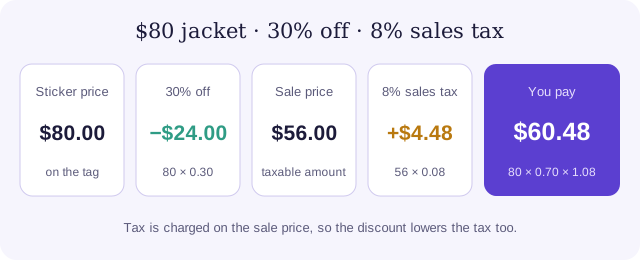
That order is the usual one in the United States, because a store discount lowers the amount that is taxed. The exceptions, such as manufacturer coupons, are covered below and built into the calculator.
How to Use This Discount and Sales Tax Calculator
- Discount + tax is the main tab. Type the price, pick a percent off (or an amount off), and set the tax rate. Add a second discount if a coupon stacks on top of a sale.
- Price before tax works backwards from a receipt total. It also finds the price before a sale if you know the percent off.
- Find the discount turns two prices into a percent off, or a sale price and a percent into the original price.
- Compare deals sets two offers side by side, including buy one get one, and says which costs less after tax.
Choose your currency symbol above the tabs. Open “Tax rules for coupons” if one of your discounts is a manufacturer coupon. Everything runs in your browser, so the prices you type stay on your device.
How to Calculate a Discount With Sales Tax
Three small formulas do all the work. Write the discount as a decimal, so 30% is 0.30.
- Discount amount = price × discount rate. Here 80 × 0.30 = $24.00.
- Sale price = price − discount amount, or price × (1 − rate). Here $56.00.
- Total = sale price × (1 + tax rate). Here 56 × 1.08 = $60.48, of which $4.48 is tax.
Because multiplication can be done in any order, the whole job is one number: price × 0.70 × 1.08 = price × 0.756. The table below shows that “checkout factor” for common cases. It is the quickest way to estimate a price in a shop.
What you really pay, as a share of the sticker price
| Discount | With 5% tax | With 8% tax | With 10% tax |
|---|---|---|---|
| 10% off | 94.5% | 97.2% | 99.0% |
| 20% off | 84.0% | 86.4% | 88.0% |
| 30% off | 73.5% | 75.6% | 77.0% |
| 40% off | 63.0% | 64.8% | 66.0% |
| 50% off | 52.5% | 54.0% | 55.0% |
Read it as: at 30% off with 8% tax, you pay 75.6% of the tag. The table also shows why a small sale in a high-tax place barely helps. At 10% tax, “10% off” leaves you paying 99% of the tag, so tax has taken back almost all of the saving.
Find the total.
- Discount = 80 × 0.30 = $24.00.
- Sale price = 80 − 24 = $56.00.
- Tax = 56 × 0.08 = $4.48.
- Total = 56 + 4.48 = $60.48.
Answer: $60.48 (you save $24.00 and pay $4.48 tax).
Is Sales Tax Charged Before or After the Discount?
In most US sales the tax is charged after the discount, on the reduced price. A store sale or store coupon lowers the price the shop charges you, so it lowers the taxable amount too. The exception is a coupon the shop is paid back for.
| Discount type | Lowers the price? | Lowers the tax? |
|---|---|---|
| Store sale or markdown | Yes | Yes |
| Store coupon or promo code | Yes | Yes |
| Manufacturer coupon | Yes | Often no: tax is on the full price |
| Gift card or store credit | No: it is a form of payment | No: tax is on the full total |
New York is a clear example. Its tax department says a retailer’s coupon lowers the taxed amount, while a manufacturer’s coupon does not, because the retailer is reimbursed by the manufacturer. See the state rule in its coupons guidance. Other states differ, so check yours before relying on a rule of thumb.
Compare a store coupon with a manufacturer coupon.
- Store coupon: taxable amount is 150 − 25 = $125. Tax = 125 × 0.0625 = $7.81. Total = $132.81.
- Manufacturer coupon: tax is on the full $150. Tax = 150 × 0.0625 = $9.38. Total = 125 + 9.38 = $134.38.
Answer: The manufacturer coupon costs $1.57 more, because the $25 did not reduce the tax.
To model this, untick “Discount lowers the taxable price” in the calculator’s tax rules. A gift card is not a discount at all. Enter the full price and tax, then subtract the card from the total yourself.
Stacked Discounts: Why 20% Plus 10% Is Not 30%
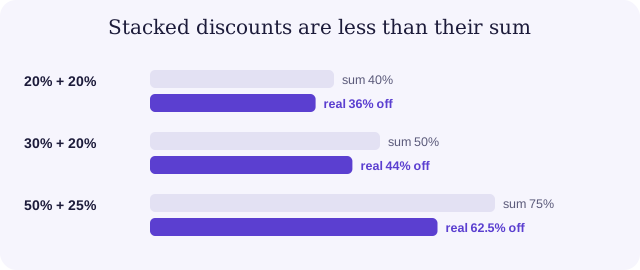
A second discount applies to the price that is left, not to the original. So two percentages never add up. 20% off then 10% off leaves 0.80 × 0.90 = 0.72 of the price, which is 28% off, not 30%.
| Two discounts | Simple sum | Real discount |
|---|---|---|
| 10% + 10% | 20% | 19% |
| 20% + 20% | 40% | 36% |
| 30% + 20% | 50% | 44% |
| 40% + 20% | 60% | 52% |
| 50% + 25% | 75% | 62.5% |
| 60% + 30% | 90% | 72% |
The gap grows with the size of the discounts. “Extra 25% off already reduced prices” sounds like a lot, but on a 50% markdown it only takes you to 62.5% off.
Percent first or amount first?
When one discount is a percentage and the other a flat amount, the order changes the price. Take $200 with 25% off and a $30 coupon:
| Order | Steps | Price before tax | Total at 8% tax |
|---|---|---|---|
| Percent first | 200 × 0.75 = 150, then −30 | $120.00 | $129.60 |
| Amount first | 200 − 30 = 170, then × 0.75 | $127.50 | $137.70 |
The percentage-first order is cheaper for you by $8.10 here, because the flat coupon is taken off after the percentage has already done its work. Your checkout decides the order. When you enter two mixed discounts, the calculator tells you what the other order would cost, so you can see what your cart is doing.
The tag says $120.
- After 40% off: 120 × 0.60 = $72.00.
- After 15% more: 72 × 0.85 = $61.20. The real discount is 49%, not 55%.
- Tax = 61.20 × 0.0725 = $4.44 (4.437 rounded).
- Total = 61.20 + 4.44 = $65.64.
Answer: $65.64.
Find the Price Before Tax From a Receipt
Sometimes you only know the total. To remove tax, divide by 1 plus the rate. Do not subtract the rate, because the tax was a percentage of the smaller number, not of the total.
- Price before tax = total ÷ (1 + tax rate).
- Tax paid = total − price before tax.
Find the price before tax.
- 108 ÷ 1.08 = $100.00.
- Tax = 108 − 100 = $8.00.
Answer: $100.00 before tax. Subtracting 8% of 108 would give $99.36, which is wrong.
If the item was on sale, add the percent off to also get the price before the sale: original = price before tax ÷ (1 − discount). A $59.99 total at 7.25% tax and 25% off gives 59.99 ÷ 1.0725 = $55.93 before tax, and 55.93 ÷ 0.75 = $74.57 before the sale.
Prices in the UK and most of Europe already include VAT, so this tab is how you find the net price. Standard UK VAT is 20%, so a £120 shelf price is £100 before VAT.
Percent Off or Amount Off: Which Is Better?
A percentage saves more on big prices and a flat amount saves more on small ones. They are equal at the break-even price = amount ÷ rate. Above that price, take the percentage. Below it, take the amount.
| Compare | Break-even price | Better below it | Better above it |
|---|---|---|---|
| $5 off vs 10% off | $50.00 | $5 off | 10% off |
| $10 off vs 15% off | $66.67 | $10 off | 15% off |
| $10 off vs 20% off | $50.00 | $10 off | 20% off |
| $20 off vs 25% off | $80.00 | $20 off | 25% off |
| $25 off vs 30% off | $83.33 | $25 off | 30% off |
For example, “$10 off or 15% off” is a tie at $66.67 (10 ÷ 0.15). On a $40 order $10 off saves $10 while 15% saves $6. On a $120 order 15% saves $18. When both are store discounts, tax does not change the winner, because tax is the same share of whichever sale price is left.
Buy One Get One and Multi-Buy Deals, Compared
A BOGO deal is a discount in disguise. Divide what you save by what you would have paid at full price to get the real percent off.
| Deal | Items you buy | Real discount |
|---|---|---|
| Buy 1 get 1 free | 2 | 50% |
| Buy 1 get 1 half off | 2 | 25% |
| Buy 1 get 1 half off | 3 | 16.7% |
| Buy 1 get 1 half off | 4 | 25% |
| Buy 1 get 1 half off | 5 | 20% |
| Buy 2 get 1 free | 3 | 33.3% |
Two details make BOGO tricky. Only complete pairs count, so a half-price deal on 3 items gives a 16.7% discount, not 25%. And a deal only beats a straight percentage if the percentage is lower: BOGO half off (25% on a pair) loses to a plain 30% off, but BOGO free (50%) wins.
The “Compare deals” tab applies all of this and adds tax, and it shows the price per item. It assumes the items cost the same. If they differ, enter the average price.
Sales Tax Rates: What to Enter
The calculator needs the rate you will be charged at the register. In the US that is the state rate plus any county or city rate, so it varies by address. These are state-level rates from the Tax Foundation’s 2026 table:
| State | State sales tax |
|---|---|
| California | 7.25% |
| Tennessee | 7.00% |
| Washington | 6.50% |
| Texas, Illinois | 6.25% |
| Florida | 6.00% |
| New York | 4.00% |
| Colorado | 2.90% |
| Alaska, Delaware, Montana, New Hampshire, Oregon | None at state level (Alaska allows local tax) |
Local rates are added on top, so the combined rate is higher than the state figure. The same source puts Louisiana, Tennessee and Washington among the highest combined averages. Look up your exact rate on your receipt or your state’s tax site. For VAT or GST countries, enter the percentage that applies to the item.
Rounding to the Cent
Money has two decimal places, so every step is rounded to the cent. The calculator works in whole cents and rounds halves up, a common convention. It rounds the discount, then the tax, so each line of the breakdown adds exactly to the total.
Receipts can still differ by a cent. Some shops round the tax on each item instead of on the cart, and some round half to even. For a multi-item order the calculator applies the discount and tax to the line total, which is the common case. If your receipt is off by a cent, check how the shop rounds before suspecting the maths.
Our Take: Overrated, Underrated and Plain Wrong
These are opinions, not rules.
Overrated: “up to 70% off” banners. The number is the best item in the sale, not the typical one. Look at the price you will actually pay.
Underrated: the single multiplier. Work out price × (1 − discount) × (1 + tax) once and you can estimate any tag in your head.
Plain wrong: “two discounts add up.” 20% and 10% make 28%, not 30%. The other myth is that tax is always charged on the original price. For store discounts it is not.
How We Tested This Calculator
We compared the calculator with a separate exact-fraction script on 630 random cases across the four tabs: prices up to $99,999, quantities up to 99, percent and amount discounts, three-decimal rates, coupon-tax rules and every deal type. Every total, saving and tax figure matched to the cent. We also checked blank, zero, text and over-100% entries, which show a plain message instead of a wrong number.
Discount and Sales Tax Practice Problems With Answers
- A $45 shirt is 20% off with 6% sales tax. What is the total?
Answer
45 × 0.80 = 36.00; tax 2.16; total $38.16 - A total of $53.50 includes 7% tax. What was the price before tax?
Answer
53.50 ÷ 1.07 = $50.00 - A coat goes from $140 to $98. What is the percent off?
Answer
42 ÷ 140 = 30% - A sale price is $63 after 30% off. What was the original price?
Answer
63 ÷ 0.70 = $90.00 - Which saves more on a $90 item, $12 off or 15% off?
Answer
15% of 90 = $13.50, so 15% off saves $1.50 more. The break-even is 12 ÷ 0.15 = $80.
For word problems like these, the math word problem solver can show the steps.